Based on a chapter called the Final Judgement in Cardinal Carlo Maria Martini’ s book “Piccolo Manuale della Speranza – Vivere con Fiducia il Nostro Tempo” [A Small manual of Hope – Living our lives in Trust]. Giunti Editore S.p.A. Milano, 2012.
All biblical quotations are from ‘The Jerusalem Bible’, Darton, Longman & Todd, London, 1966.
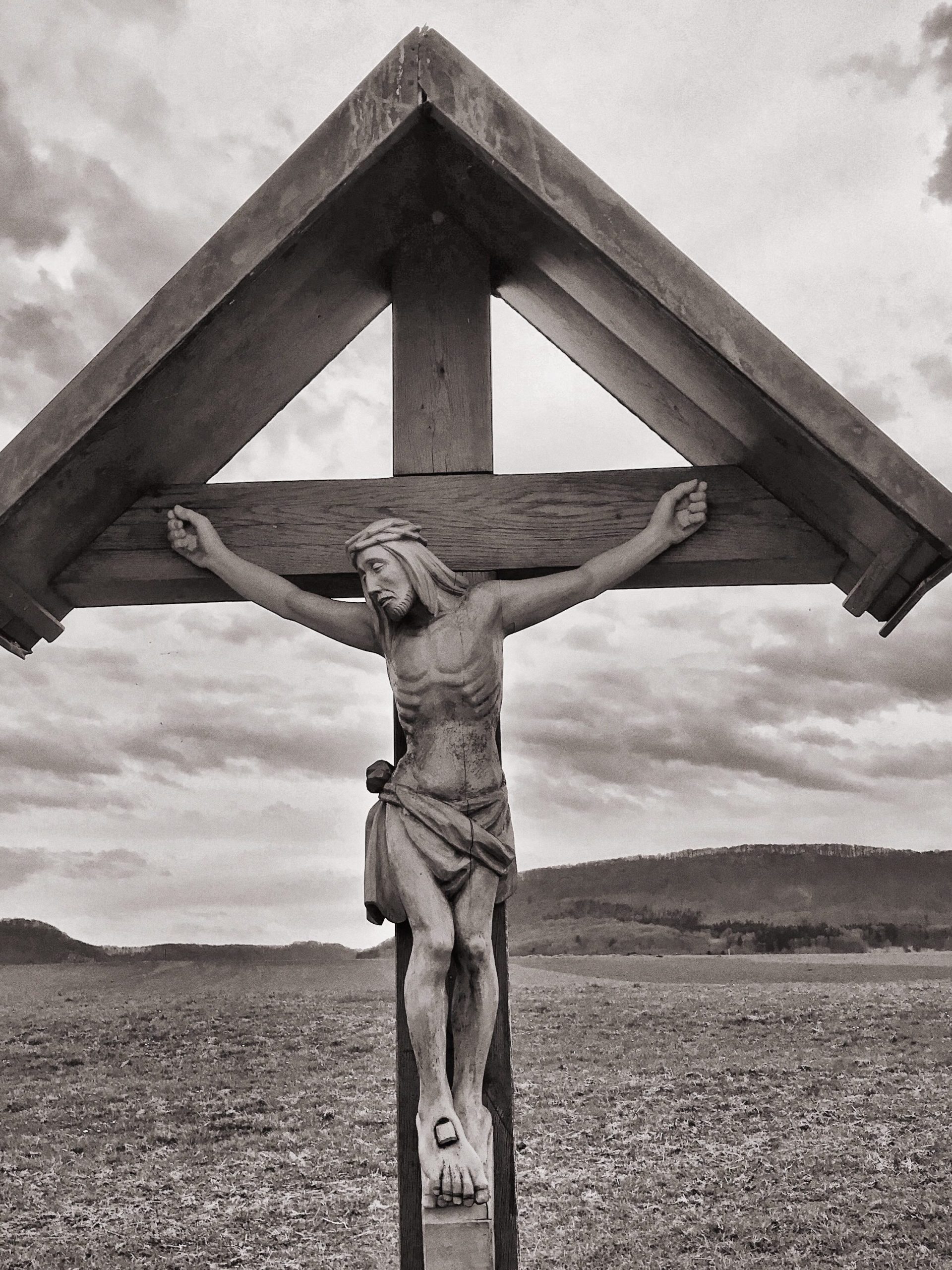
For this reflection we choose a word that at first may elicit discomfort and repulsion: cross.
However, it is one of the most frequently used words by Christians; the sign of the cross is in fact one of the first things that are taught to children.
The word “cross” puts us immediately on the defensive and it is not rare that one hears something like “the Christian message would be nice if it were not for the cross.”
So, let us see what this means, as always using some passages from Mark’s gospel. The various types of occurrence of the word “cross” or of the verb “crucify”, may be grouped into three sections.
There are the texts that describe Jesus’ crucifixion: in chapter 15, for example, the crowd “shouted back, ‘Crucify him’ […] they shouted louder, ‘Crucify him’. […] So, Pilate […] having ordered Jesus to be scourged, handed him over to be crucified.” (vv. 13-15)*. And again “[the soldiers] led him out to crucify him”. (v. 21); “They enlisted a passer-by, Simon of Cyrene, …. to carry the cross.” (v.21). “the chief priests and the scribes mocked him among themselves in the same way… ‘Let the Christ, the king of Israel, come down from the cross now, for us to see and believe.’” This is a complete description of Jesus’ passion and the torture during which he died.
A second use of the word” cross” is found in chapter 8 of Mark’s gospel. This concerns us directly. Jesus says, “If anyone wants to be a follower of mine, let him renounce himself and take up his cross and follow me.” (v. 34). This is one of the passages that scares us most when we try to take its message seriously: take up the cross.
Finally, we find the last text, at the end of Mark’s gospel, where the angel’s proclamation of Jesus’s resurrection is described. The angel says, “You are looking for Jesus of Nazareth, who was crucified: he has risen, he is not here.” (16,6). It is a cry of victory.
So, we have distinguished among three type of events where the words “cross” or “crucified” are used in Mark’s gospel. A few texts where the subject is Jesus’ sufferings; a text in which we are invited to follow the way of the cross behind Jesus; and another that affirms the triumph of the cross.
They are the three elements that are involved, each in its own way, in the Christian experience. The way we conceive Christianity depends on the order of importance we give each of these elements.
Different ways that perhaps are not all authentic, especially where some of them exclude others.
Let us clarify.
First, there is the cross that is our cross, as we find in the Mark’s text 8,34: “If anyone wants to be a follower of mine, let him renounce himself and take up his cross and follow me.” If one only sees this aspect of Christianity, one is led to a form of religiosity that – perhaps ironically – may be described as the Christianity “of moans”: the Christian experience appears to be a great burden to bear, a moral and austere weight, several duties that must be borne with patience and acceptance, sometimes passively and grumbling, though they are quite hefty. Obviously, we will be scared if we only see the word “cross” only in this light.
There is, however, a second particularly important element, that of the “liberating” nature of Christianity: it is the proclamation that Jesus’s death on the cross was won by life.
This is the fundamental Gospel of the cross. It is the Gospel that makes us move from desperation to hope, from loneliness to friendship, from sadness to joy, from weakness to strength of the spirit of God in us.
This is the true meaning of the cross: it is the power of God that is shown in Jesus crucified and risen.
We have here a new face of the cross: it shows the Christianity “of the gift”. Why so much hope in the cross, this power of the cross? Because Jesus on the cross has loved us to death and in him God has loved us and has remembered us, and he has revealed himself as a gift.
Therefore, all human existence appears to us as a gift of a loving God and commits us to live our life by donating it.
From a Christianity of moans and whining, we transition to a liberating Christianity and then to a Christianity of strength, of life, of resurrection, of donation.
This is the real way to understand the cross’ message in Christianity, and it is in this way that the canticles of the New Testament, like for example that of the Book of Revelation, sing the praises of the cross:
“You are worthy to take the scroll
and break the seals of it,
because you were sacrificed, and with your blood
you brought men for God
of every race, language, people and nation
and made them a line of kings and priests,
to serve our God and to rule the world.(Rv 5,9-10)
* 15, 13-15 means chapter 15, verses 13 to 15.